
Why Pet Stores Need AI Chatbots in 2026
The pet industry hit $150 billion in the U.S. alone in 2025, and online pet product sales continue to grow at double-digit rates. But growth brings complexity. More SKUs, more customer questions, and higher expectations for instant support.
Here’s what most pet store owners deal with daily:
- Repetitive questions — “Is this food grain-free?” “What size collar fits a 40-pound dog?” “Do you ship to Canada?” These account for 60-70% of all incoming support messages.
- After-hours traffic — Pet owners shop evenings and weekends. If nobody’s online to answer questions at 9 PM, you lose the sale.
- High cart abandonment — Pet products often require confidence before purchase. Customers hesitate over ingredients, sizing, or compatibility, and abandon their cart when they can’t get a quick answer.
- Scaling support costs — Hiring another support agent costs $35,000-$50,000 per year. An AI chatbot handles thousands of conversations for a fraction of that.
An AI chatbot doesn’t just answer questions. It becomes a 24/7 product expert that knows your entire catalog, your shipping policies, and your return process—and delivers that information in seconds.
What an AI Chatbot Actually Does for Pet Stores
Let’s get specific. Here are the real-world use cases where AI chatbots deliver measurable value for pet retailers:
1. Product Recommendations Based on Pet Profiles
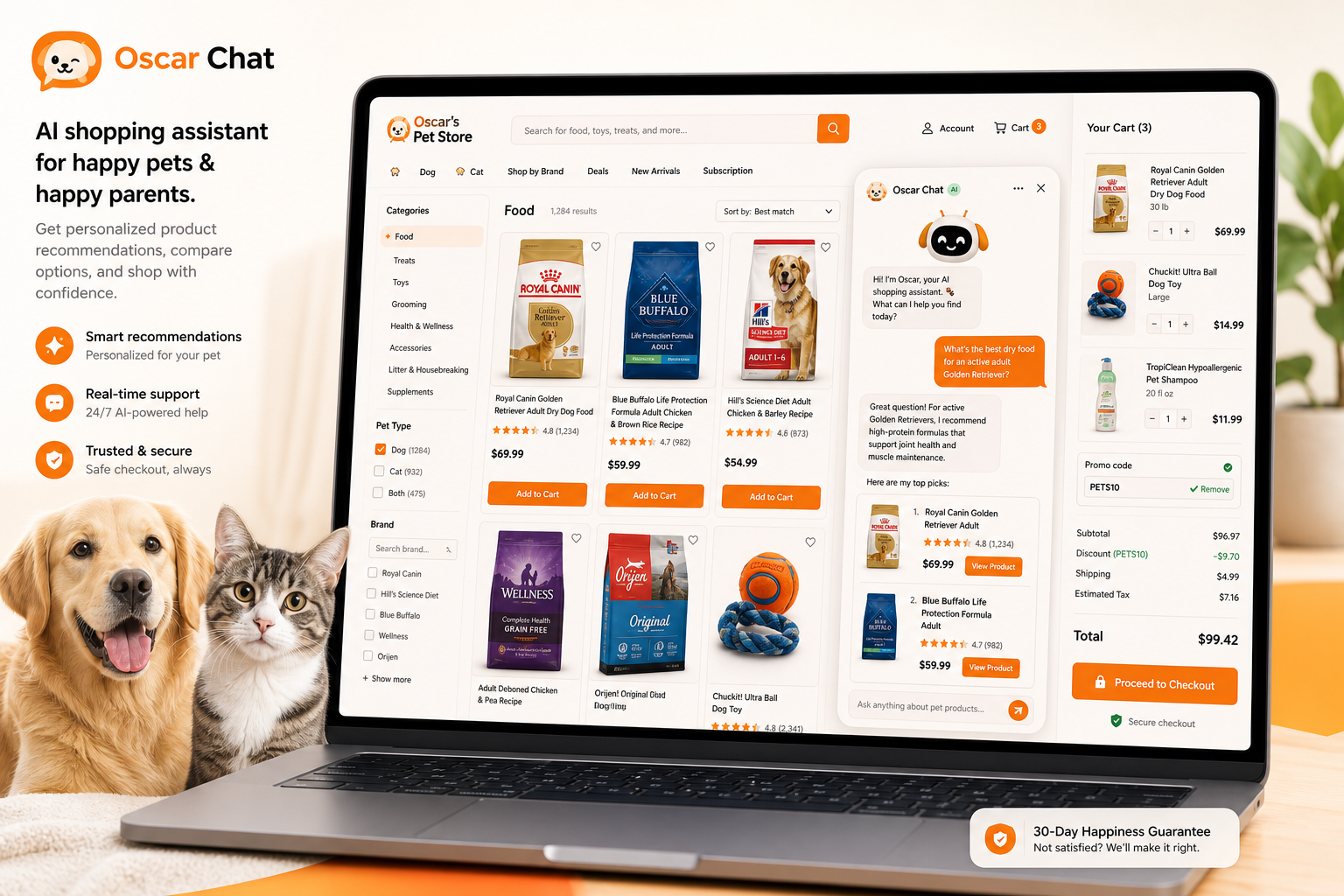
A customer types: “I have a 3-year-old French Bulldog with a sensitive stomach. What food do you recommend?”
A well-trained AI chatbot pulls from your product catalog and responds with 2-3 specific options, linking directly to product pages. No human agent needed. This kind of guided selling increases average order value because the chatbot can also suggest complementary products like supplements or treats.
2. Instant Answers to Pre-Purchase Questions
Before buying a harness, leash, or crate, pet owners want to confirm sizing, materials, and compatibility. An AI chatbot trained on your product specs can answer these questions instantly:
- “Will this crate fit in my SUV?”
- “Is this leash strong enough for a 90-pound dog?”
- “Does this cat tree come assembled?”
Every question answered before checkout is one fewer abandoned cart.
3. Order Tracking and Shipping Updates
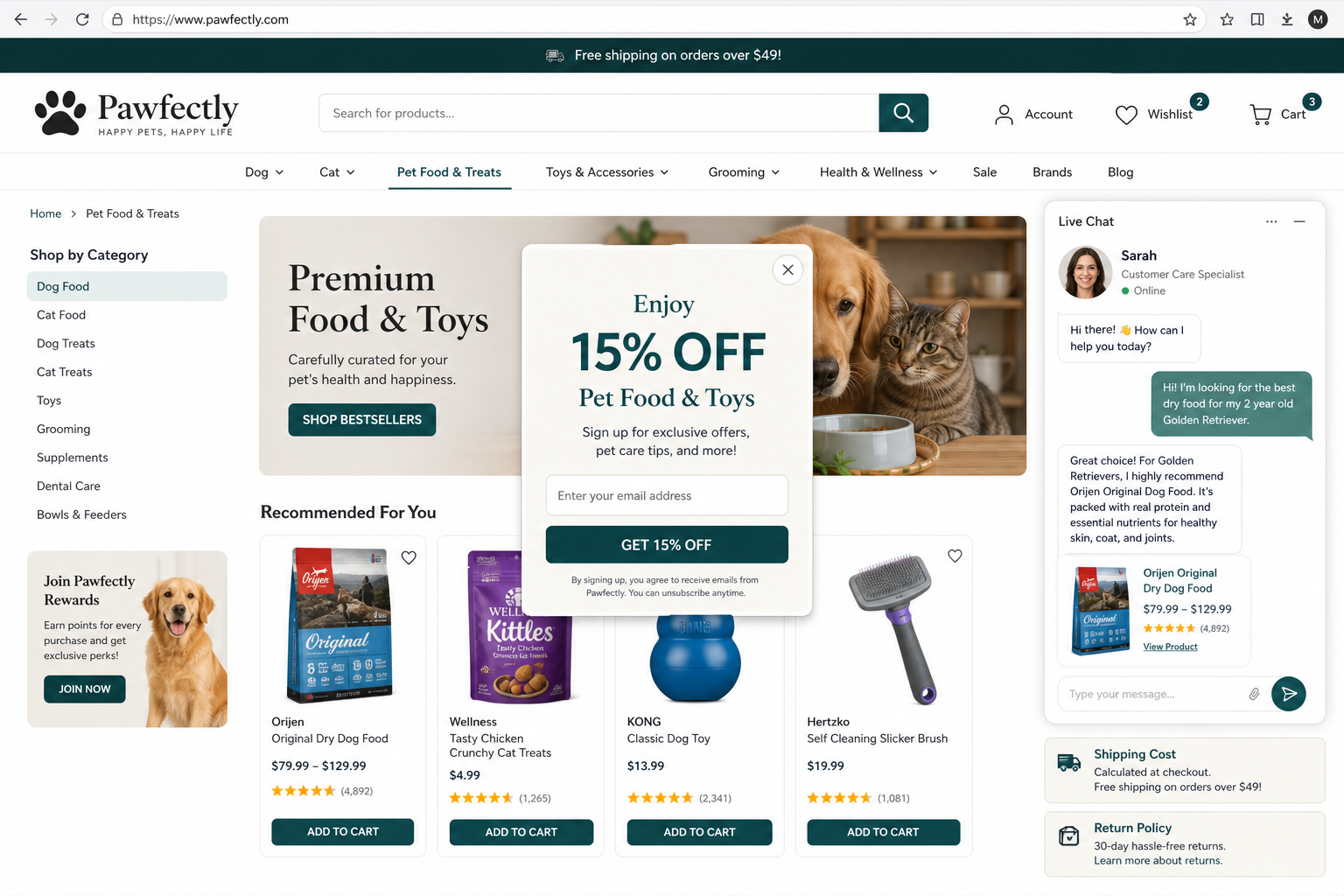
“Where’s my order?” is the single most common support question in ecommerce. An AI chatbot integrated with your order management system can pull tracking info automatically and share it with the customer—no ticket created, no agent time spent.
4. Subscription and Reorder Management
Many pet stores offer subscription models for food and supplies. A chatbot can help customers modify their subscription frequency, swap products, skip a delivery, or cancel—all through a conversational interface that feels easier than navigating account settings.
5. Basic Pet Care Guidance
Pet owners trust stores that educate them. An AI chatbot can provide basic advice on feeding schedules, grooming frequency, or seasonal care tips. This builds trust and positions your store as an authority, not just a retailer. Just make sure to include a disclaimer that the chatbot isn’t a substitute for veterinary advice.
6. Lead Capture and Email Collection
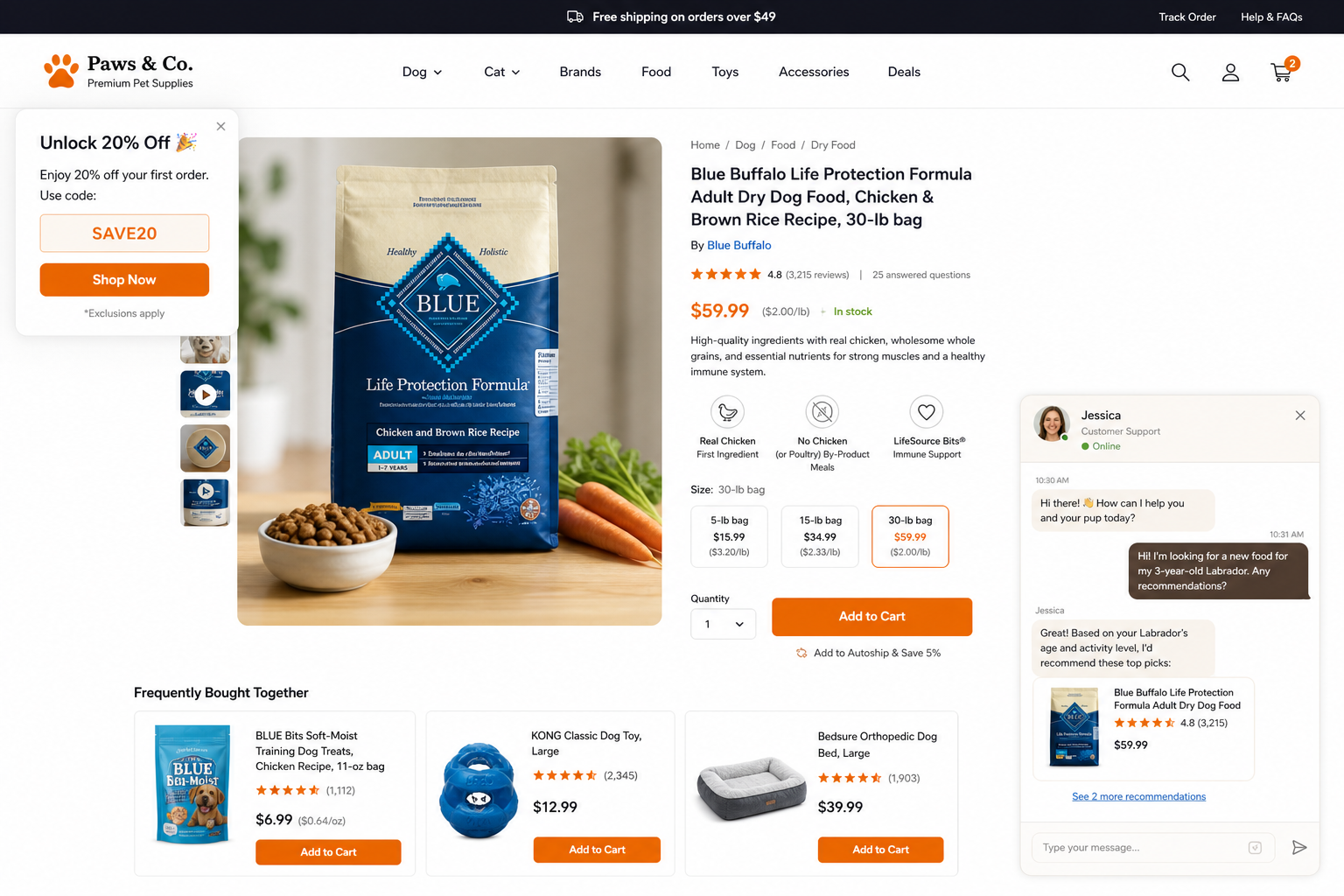
When a visitor asks about a product that’s out of stock, the chatbot can collect their email for a restock notification. When a new visitor browses without buying, it can offer a discount code in exchange for an email. These micro-conversions compound over time.
Key Features to Look for in a Pet Store Chatbot
Not every chatbot platform is built for retail. Here’s what matters when you’re choosing one for a pet store:
| Feature | Why It Matters for Pet Stores |
|---|---|
| AI-powered responses | Understands natural language queries like “best food for a senior cat with kidney issues” |
| Product catalog training | Learns your specific products, ingredients, pricing, and specs |
| Live chat handoff | Routes complex questions (allergic reactions, medical concerns) to a human agent seamlessly |
| Multilingual support | Serves diverse customer bases without separate bot configurations |
| Ecommerce integrations | Connects with Shopify, WooCommerce, or your custom platform for real-time product and order data |
| Customizable widget | Matches your brand colors, tone, and personality (pet brands tend to be playful) |
| Analytics dashboard | Shows which questions customers ask most, resolution rates, and conversion impact |
Oscar Chat covers all of these features out of the box. It’s particularly well-suited for small and mid-sized pet stores because it can be trained on your website content automatically—no manual FAQ building required. If you’re evaluating options, it’s worth understanding the difference between chatbots and live chat to decide what blend works best for your store.
AI Chatbot Platforms Compared for Pet Stores
Here’s how the leading chatbot options stack up for pet retail specifically:
| Platform | Free Plan | AI Responses | Shopify Integration | Custom Training | Best For |
|---|---|---|---|---|---|
| Oscar Chat | Yes | Yes (GPT-powered) | Yes | Auto-trains on site | SMBs wanting fast setup with AI |
| Tidio | Yes (limited) | Yes (Lyro AI) | Yes | Manual FAQ upload | Stores needing visual flow builders |
| Intercom | No | Yes (Fin AI) | Yes | Knowledge base | Enterprise with large support teams |
| Crisp | Yes (basic) | Limited | Yes | Basic triggers | Teams prioritizing shared inbox |
| LiveChat | No | Add-on only | Yes | Manual setup | Agent-heavy support operations |
For most independent pet stores and small chains, the combination of a free plan, automatic AI training, and easy Shopify integration makes Oscar Chat the most practical starting point. If you’re currently using another platform, check out our comparisons of Tidio alternatives, Intercom alternatives, and Crisp alternatives for a detailed breakdown.
The ROI of AI Chatbots for Pet Retail
Let’s talk numbers. Here’s what a typical small-to-midsize pet store can expect after deploying an AI chatbot:
| Metric | Before Chatbot | After Chatbot | Impact |
|---|---|---|---|
| Average response time | 4-8 hours | Under 5 seconds | 99% faster |
| Support tickets per month | 500+ | 150-200 | 60-70% reduction |
| Cart abandonment rate | 72% | 58-63% | 10-15% decrease |
| After-hours conversions | Near zero | 15-20% of total | New revenue stream |
| Monthly support cost | $3,000-5,000 | $1,200-2,000 | 50-60% savings |
The math is straightforward. If your chatbot prevents even 10 cart abandonments per month at an average order value of $65, that’s $650 in recovered revenue—often enough to cover the cost of the tool itself. For more on reducing lost sales, see our guide on reducing cart abandonment on Shopify.
How to Set Up an AI Chatbot for Your Pet Store
Getting started doesn’t require a developer or a month-long implementation. Here’s the practical process:
Step 1: Choose Your Platform
Start with what you need today, not what you might need in two years. For most pet stores doing under $1M in annual revenue, a platform like Oscar Chat gives you AI-powered responses, live chat fallback, and ecommerce integrations without enterprise pricing. If you want to explore the best free live chat options first, that’s a reasonable starting point too.
Step 2: Train the AI on Your Content
This is where the real value comes from. Upload or connect your:
- Product catalog — names, descriptions, ingredients, sizing charts
- FAQ pages — shipping, returns, subscription management
- Care guides — feeding guides, breed-specific advice, seasonal tips
- Policy documents — warranty, satisfaction guarantees, loyalty programs
Oscar Chat can crawl your website and auto-ingest this content, so you don’t have to manually copy-paste every FAQ. The AI learns from your actual pages and product descriptions.
Step 3: Customize the Chat Widget
Pet brands tend to have distinct visual identities—bright colors, playful fonts, animal mascots. Make sure your chatbot widget matches. Customize the:
- Widget color to match your brand palette
- Welcome message (e.g., “Hey there! Looking for the perfect treat for your pup? Ask me anything.”)
- Avatar or icon (consider using your brand mascot)
- Position and trigger rules (e.g., show after 10 seconds on product pages)
Step 4: Set Up Handoff Rules
Define when the chatbot should escalate to a human agent. For pet stores, good handoff triggers include:
- Any mention of allergic reactions or health emergencies
- Complaints or negative sentiment
- Requests for veterinary advice beyond basic care
- Complex order issues (wrong item shipped, damaged products)
Understanding when to use a chatbot vs. live chat is critical. The best setup uses both: AI handles volume, humans handle nuance.
Step 5: Launch and Iterate
Don’t wait for perfection. Launch with your core knowledge base and monitor the analytics dashboard for the first two weeks. You’ll quickly see which questions the AI handles well and which ones need more training data. Add new content to the knowledge base based on actual customer conversations.
Real Scenarios: AI Chatbots in Pet Store Operations
To make this concrete, here are three scenarios showing how different types of pet stores use AI chatbots:
Scenario 1: Independent Pet Boutique
A single-location pet boutique with an online store does $300K/year in revenue. The owner handles support personally, spending 2-3 hours daily on emails and DMs. After deploying an AI chatbot trained on their 200-product catalog, automated responses handle 65% of inquiries. The owner reclaims 10+ hours per week and redirects that time to sourcing new products and building supplier relationships.
Scenario 2: Online Pet Food Subscription
A DTC pet food brand ships 5,000 subscription boxes monthly. Their #1 support topic is subscription management—pausing, swapping flavors, updating delivery addresses. An AI chatbot handles these requests conversationally, reducing support tickets by 70% and cutting their need for a third support agent they were about to hire.
Scenario 3: Multi-Location Pet Store Chain
A regional chain with 8 locations and a Shopify store uses an AI chatbot to unify online and in-store support. The chatbot answers questions about in-store product availability, provides directions to the nearest location, and handles online order inquiries. Consistent information across all channels reduces customer confusion and improves satisfaction scores.
Common Mistakes to Avoid
Deploying a chatbot isn’t plug-and-play. Here are the pitfalls pet store owners hit most often:
- Skipping product training — A generic chatbot that can’t answer “Is this food good for puppies?” is worse than no chatbot at all. Invest time in training the AI on your specific catalog.
- No human fallback — Customers get frustrated fast when a bot loops on questions it can’t answer. Always have a clear path to a human agent.
- Ignoring analytics — Your chatbot dashboard tells you exactly what customers want to know. Use that data to improve product descriptions, update FAQs, and identify gaps in your catalog.
- Over-automating — Don’t try to automate veterinary advice, complaint resolution, or sensitive situations. These require empathy and expertise that AI can’t replicate.
- Forgetting mobile — Over 60% of pet product browsing happens on mobile. Make sure your chat widget is optimized for small screens and doesn’t block critical content.
Integrating Your Chatbot with Your Existing Stack
A chatbot works best when it’s connected to your other tools. Key integrations for pet stores include:
- Shopify / WooCommerce — for real-time product data, inventory levels, and order tracking
- Email marketing (Klaviyo, Mailchimp) — to sync leads captured by the chatbot into your email flows
- Help desk (Zendesk, Help Scout) — for seamless ticket creation when the bot escalates
- CRM — to track customer history and provide context for human agents
- Review platforms — to prompt happy customers for reviews post-purchase
Oscar Chat integrates natively with Shopify and supports webhook connections to most marketing and support tools. For Shopify store owners, our guide on the best AI chatbot for Shopify covers integration details in depth.
Frequently Asked Questions
What is an AI chatbot for pet stores?
An AI chatbot for pet stores is an automated virtual assistant embedded on your website or online store that answers customer questions about pet products, food, accessories, and care. It uses natural language processing to understand queries and provide instant, accurate responses without requiring a human agent.
How much does an AI chatbot cost for a small pet store?
Most AI chatbot platforms offer plans starting from free tiers up to $50–100 per month for small businesses. Oscar Chat, for example, offers a free plan with core features and a Pro plan that includes AI-powered responses, making it affordable for independent pet stores and small chains.
Can an AI chatbot recommend specific pet food or products?
Yes. When trained on your product catalog, an AI chatbot can recommend specific food brands based on pet breed, age, dietary needs, or allergies. It can also suggest accessories, toys, and grooming products based on the customer’s pet type and preferences.
Will an AI chatbot replace my pet store’s customer service team?
No. An AI chatbot handles repetitive questions like store hours, shipping policies, product availability, and basic care advice. This frees your human team to focus on complex queries, veterinary-related concerns, and high-value customer interactions that require personal expertise.
How does an AI chatbot reduce cart abandonment in pet ecommerce?
AI chatbots reduce cart abandonment by answering last-minute questions about products, shipping, and returns before checkout. They can also offer real-time sizing guidance for pet accessories, clarify ingredient lists, and proactively engage customers who hesitate on the checkout page.
Can I use an AI chatbot on my Shopify pet store?
Yes. Most modern AI chatbot platforms integrate directly with Shopify. Oscar Chat can be installed on any Shopify store within minutes and trained on your specific product catalog, policies, and FAQs to provide relevant answers from day one.
How long does it take to set up an AI chatbot for a pet store?
Basic setup takes 10–30 minutes for most platforms. You install a code snippet or app, customize the widget’s appearance, and upload your knowledge base. AI-powered chatbots like Oscar Chat can automatically learn from your website content, reducing setup time significantly.
What questions do pet store customers ask most often?
The most common questions include product availability, shipping times, return policies, food ingredient details, breed-specific recommendations, sizing for collars and harnesses, subscription options for recurring deliveries, and basic pet care advice like feeding schedules.
Can an AI chatbot handle multiple languages for my pet store?
Yes. Many AI chatbot platforms support multilingual conversations. This is especially useful for pet stores serving diverse communities or selling internationally. The chatbot detects the customer’s language and responds accordingly without needing separate configurations.
How do I measure the ROI of an AI chatbot on my pet store website?
Track metrics like support ticket volume reduction, average response time, conversion rate changes, cart abandonment rate, and customer satisfaction scores. Most chatbot dashboards provide analytics showing how many conversations were resolved without human intervention and how many led to a purchase.
Start Selling More and Supporting Less
Pet store customers have specific, product-driven questions that are perfectly suited for AI automation. An AI chatbot trained on your catalog turns every website visit into a guided shopping experience—day or night, without adding headcount.
The stores that adopt this early gain a compounding advantage: lower support costs, higher conversion rates, and customer data that informs every decision from inventory to marketing.