
Why Website Scraping Is a Strong Starting Point
Your website already contains a lot of the information your bot needs: product descriptions, pricing pages, FAQ pages, contact details, shipping and return policies, service explanations, and onboarding steps. When you connect a website to an AI bot, the bot can crawl those pages, collect the content, and use it as a knowledge base.
For ecommerce brands, this is especially useful because visitors usually ask the same things: Do you ship to my country? How does this work? What is the price? Is this compatible with my store? How do I get support?
Website content gives structure. A transcript gives context. If you recorded a product demo, onboarding walkthrough, or tutoria, the transcript often contains the best parts of your explanation: how you naturally describe the product, what details you emphasize first, which objections you answer, which examples you use, and what tone sounds most human for your brand.
The second version gives the bot a more natural tone. It also shows how to explain value, not just features.
The Best Training Formula: Website + Transcript + Manual Notes
- Website scraping gives the bot your core facts and public-facing content.
- Video transcript teaches the bot your tone of voice, preferred wording, and the way you explain things in real life.
- Manual additions cover sales contact details, Calendly links, escalation rules, product limitations, internal guidelines, and answers not yet on the site.
This is the setup we recommend for Oscar Chat too. It keeps the bot grounded in real content, but still lets you refine the parts that matter most.
Step 1: Crawl the Website
Start by adding your website URL to the training section of your AI bot. Most modern systems can crawl the site automatically. The bot then scans the pages, collects visible text, groups the content by topic, and builds a knowledge base.
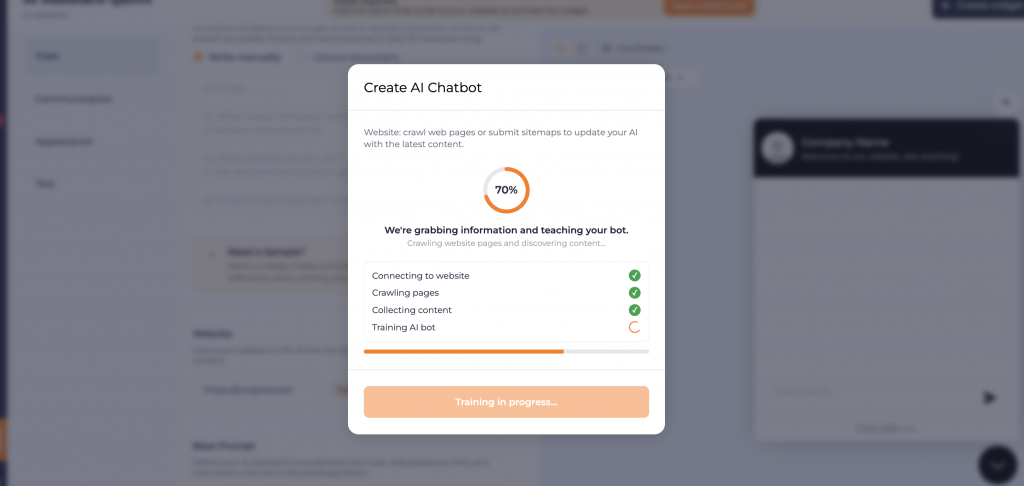
Step 2: Clean Up the Content Before Training
- Outdated pricing
- Duplicate pages
- Vague copy
- Missing FAQs
- Broken links
- Mixed messaging
If your site is messy, the bot will learn messy habits. If you want the bot to answer clearly, the site should already be clear.
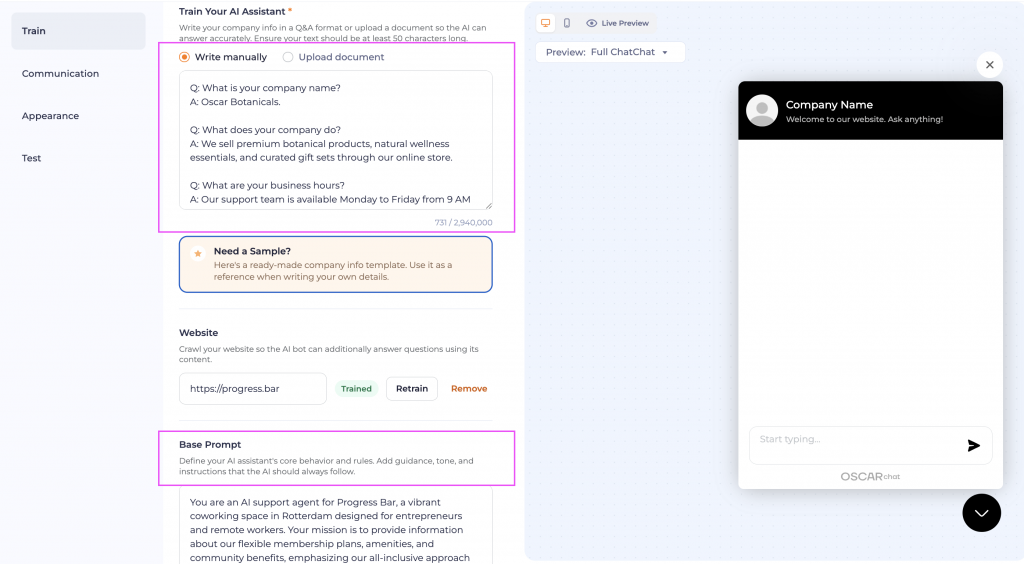
Step 4: Add Manual Instructions for Tone and Behavior
This is where the bot starts to feel like your brand. Your transcript can help define short vs. detailed answers, friendly vs. formal tone, when to ask a follow-up question, when to hand off to a human, and how to reply in different languages.
- Keep answers short and practical.
- Use the same tone as our website.
- If the question is about pricing, answer directly.
- If the question is outside our scope, say so clearly.
- Offer a handoff to live chat when the user needs a human.
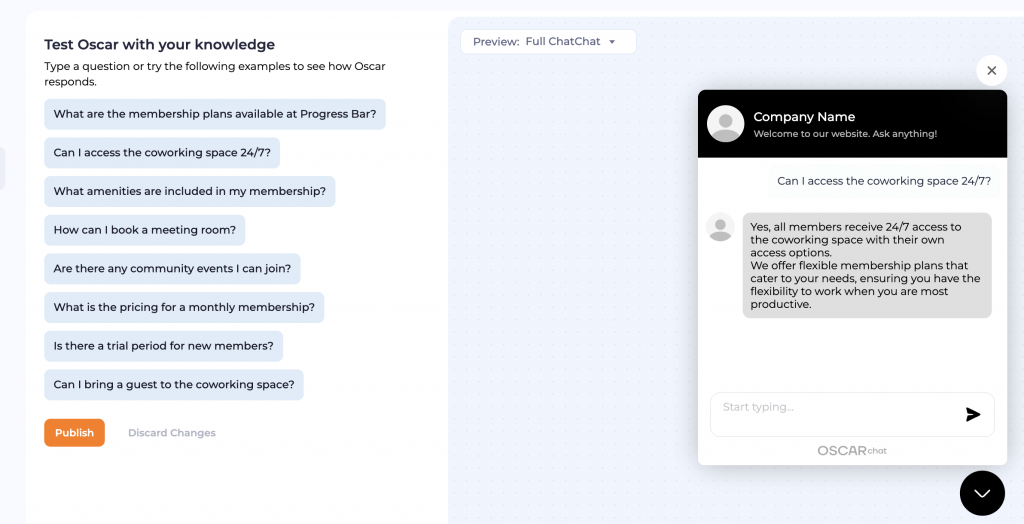
Step 5: Test the Bot on Real Questions
Try questions that come from real customer behavior: How does this work? Can I connect this to my site? Do you support my language? Where do I book a call? What if the bot does not know the answer?
If the bot gives too much detail, shorten the instructions. If it gives weak answers, add better source material. If it sounds off-brand, improve the transcript-based notes.
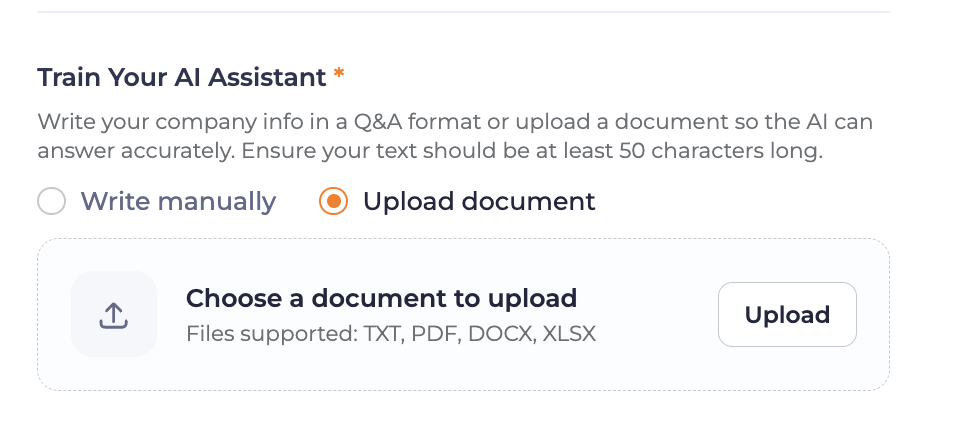
Step 6: Add Documents When the Website Is Not Enough
Sometimes the website does not contain everything the bot needs. In that case, upload documents such as onboarding docs, sales scripts, internal FAQs, support SOPs, feature sheets, and policy documents.
Step 7: Retrain the Bot Regularly
Retrain the bot whenever you update the website, launch a new feature, change pricing, add new FAQs, improve your sales process, or record a new demo or training video.
For fast-moving businesses, that may mean once a week. For smaller sites, once a month may be enough.
Why This Approach Works Better Than Plain Scraping
Plain scraping gives the bot facts. Video transcripts give the bot context. With both sources, your bot can answer using your exact positioning, sound more human, handle objections more naturally, use the same examples your team uses, and stay aligned with your sales and support language.
Common Mistakes to Avoid
- Training on bad website copy
- Dumping raw transcript text without structure
- Forgetting fallback rules
- Never retraining
- Making the bot too verbose
Final Thoughts
If you are serious about building a useful AI bot, do not stop at scraping the website. Use the site for structure, use the transcript for tone, and use manual notes for the details that matter most.
That combination gives your bot a better chance of sounding like a real extension of your team instead of a generic widget on the page. And if you want to build that setup faster, Oscar Chat gives you a practical way to train the bot on your website, refine it with extra content, and keep improving it as your business grows.
Frequently Asked Questions
What is website scraping for an AI bot?
Website scraping is the process of collecting content from your website so an AI bot can use it as training data and answer questions based on your public pages.
Why should I use a video transcript to train my bot?
A video transcript helps the bot learn how you explain things, which improves tone, clarity, and consistency.
Can I train an AI bot from a website and a transcript together?
Yes. That is usually better than using only one source, because the website gives facts and the transcript gives context.
What pages should I scrape first?
Start with your homepage, product pages, pricing page, FAQ page, contact page, and any blog posts that answer common questions.
What should I do if the bot gives wrong answers?
Review the source content, improve the training notes, and add more specific instructions or documents where needed.
How often should I retrain the bot?
Retrain whenever your website, pricing, features, or support answers change. For active businesses, weekly retraining is often a good habit.
Can a transcript replace a knowledge base?
Not completely. A transcript is helpful, but it works best together with website content and structured documents.
Does Oscar Chat support training from website content?
Yes. Oscar Chat is designed to work with website-based training, plus additional documents and manual notes when needed.
Should I make the bot answer in long or short form?
Short and clear usually works best. You can always instruct the bot to expand when the question needs more detail.
What is the biggest advantage of combining scraping and transcripts?
You get both accuracy and voice. The bot knows the facts from the site and the way your team actually talks about them.