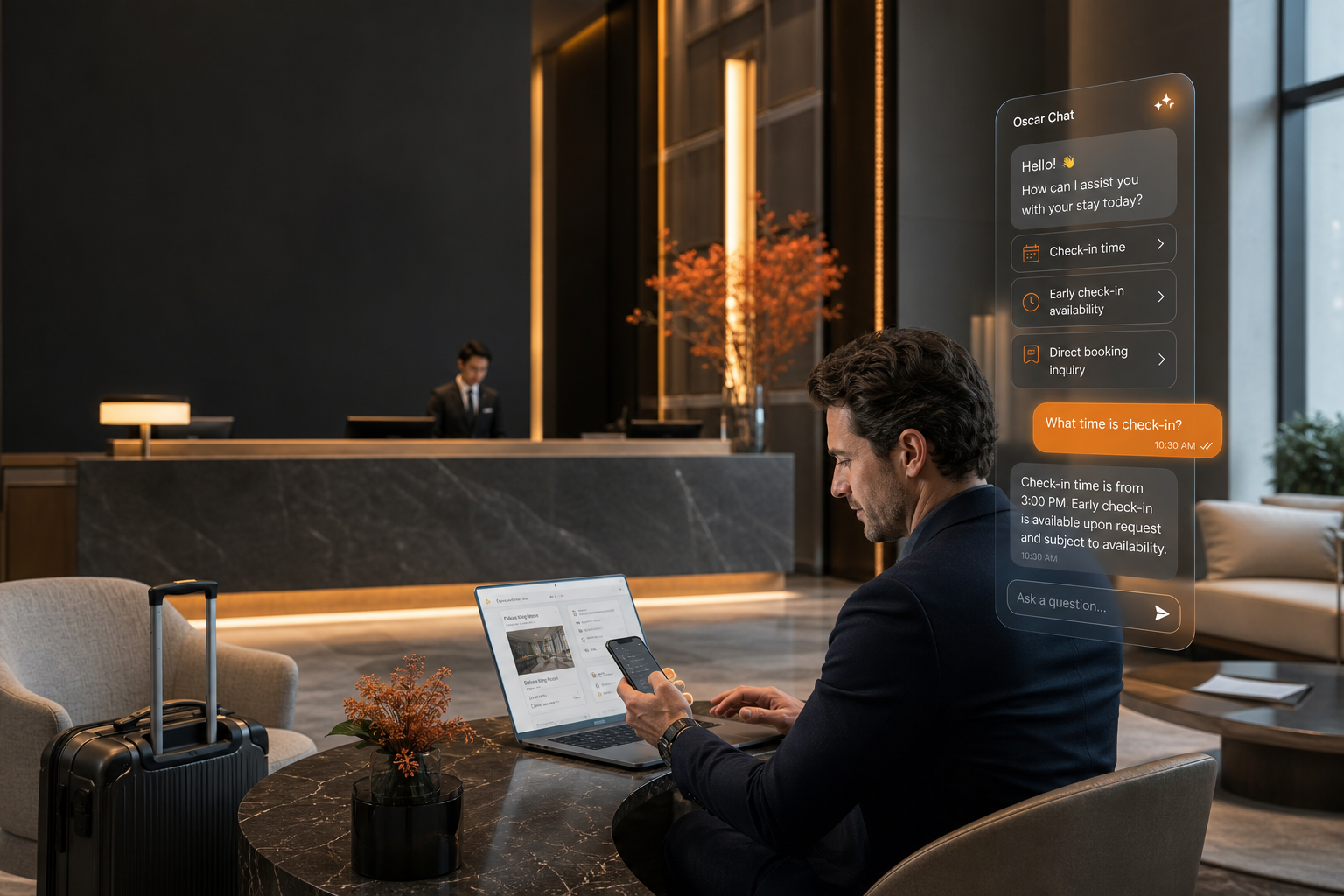
Why Hotels Need AI Chatbots in 2026
The hospitality industry operates on thin margins. OTA commissions eat 15–25% of every booking. Front desk staff turnover averages 73% annually. And guest expectations have shifted permanently—73% of travelers expect responses within five minutes, regardless of time zone or language.
An AI chatbot addresses all three pressure points simultaneously:
- Commission savings: Every booking captured directly on your website instead of through Booking.com or Expedia saves 15–25% in fees
- Staff efficiency: Automate 60–80% of repetitive questions (check-in times, parking, Wi-Fi, amenities) so staff focus on high-value interactions
- Guest satisfaction: Instant responses in 50+ languages eliminate wait times and language barriers
- Revenue capture: Upsell room upgrades, spa packages, and dining reservations at the exact moment guests are planning
Hotels that rely solely on email or phone support lose bookings to competitors who respond faster. The average hotel website visitor leaves within 8 seconds if they can’t find what they need. A chat widget that proactively offers help changes that equation entirely.
Key Use Cases: What Hotel Chatbots Actually Handle
Forget vague promises about “transforming hospitality.” Here’s what a well-configured AI chatbot for hotels handles daily:
Pre-Booking Inquiries
- Room availability and pricing for specific dates
- Pet policies, accessibility features, parking options
- Local attraction recommendations and distance from hotel
- Group booking and event space inquiries
- Comparison between room types with photo galleries
Booking Assistance
- Guiding guests through the reservation process
- Applying promo codes and loyalty discounts
- Modifying existing reservations (dates, room type, add-ons)
- Processing cancellations per your policy
- Capturing abandoned booking attempts with follow-up offers
During-Stay Support
- Room service orders and restaurant reservations
- Housekeeping requests and maintenance reporting
- Spa and activity bookings
- Wi-Fi troubleshooting and tech support
- Local dining and transportation recommendations
- Late checkout requests
Post-Stay Engagement
- Review solicitation at the right moment
- Lost-and-found inquiries
- Loyalty program enrollment
- Future stay promotions based on preferences
How AI Chatbots Drive Direct Bookings
The direct booking problem is simple: OTAs outspend hotels on marketing, then charge commissions for bookings that could have come directly. An AI chatbot shifts this dynamic by engaging visitors the moment they land on your website.
Proactive engagement: Instead of waiting for guests to find your booking engine, the chatbot triggers based on behavior. A visitor browsing room pages for 30 seconds gets a message: “Looking for availability? I can check dates and apply our best-rate guarantee instantly.”
Price matching in real-time: When guests mention they saw a lower price on an OTA, the chatbot can instantly verify and match (or beat) the rate, removing the incentive to book elsewhere.
Abandonment recovery: 81% of hotel website visitors leave without booking. A chatbot can capture email addresses and preferences from these visitors, then trigger follow-up sequences with personalized offers. Learn more about reducing abandonment with chat tools, plus how a popup builder and high-converting popup strategy can lift direct bookings.
Upsell at intent: The chatbot identifies buying signals and offers relevant upgrades. A guest asking about “romantic getaway” gets champagne packages. A family asking about kids’ activities gets the suite with connecting rooms.
Guest Experience: From Friction to Instant Resolution
Guest experience directly impacts reviews, repeat bookings, and revenue per available room (RevPAR). AI chatbots improve experience at every touchpoint:
Multilingual support without staffing costs: A 50-room boutique hotel can’t staff speakers of 20 languages. An AI chatbot handles conversations in any language naturally, translating requests to staff in their preferred language.
Consistent quality at 3 AM: Night shift staff often handle the least training and highest-stress situations. A chatbot maintains the same service quality regardless of time, handling noise complaints, lockouts, and emergency information with perfect consistency.
Personalized recommendations: By tracking conversation history, the chatbot remembers that a returning guest prefers high-floor rooms, hypoallergenic pillows, and early check-in. This data feeds into your PMS for genuinely personalized stays.
Reduced wait times: The average hotel phone hold time is 3–5 minutes. Chat responses arrive in under 3 seconds. For the 68% of guests who prefer messaging over calling, this alone transforms their perception of service quality.
Comparison: Hotel Chatbot Solutions in 2026
Choosing the right platform depends on your property size, tech stack, and primary goals. Here’s how the main options compare:
| Feature | Oscar Chat | HiJiffy | Asksuite | Quicktext |
|---|---|---|---|---|
| AI-Powered Responses | ✓ GPT-based | ✓ Proprietary | ✓ Proprietary | ✓ GPT-based |
| Setup Time | Under 5 minutes | 1–2 weeks | 1–2 weeks | 1–3 weeks |
| Multi-Language | 50+ languages | 100+ languages | 35+ languages | 25+ languages |
| Live Chat Handoff | ✓ Instant | ✓ | ✓ | ✓ |
| WhatsApp Integration | ✓ | ✓ | ✓ | ✓ |
| Custom Training on Hotel Data | ✓ URL + document upload | ✓ Guided setup | ✓ Template-based | ✓ Guided setup |
| Pricing (Entry) | Free plan available | From €100/mo | Custom quote | From €150/mo |
| Best For | Boutique hotels, B&Bs, independent properties | Mid-to-large hotel chains | Large hotel groups | Luxury & resort properties |
For independent hotels and smaller properties, Oscar Chat offers the fastest path to a working AI chatbot. You can train it on your hotel’s specific information—room types, policies, local recommendations—in minutes rather than weeks. The free plan lets you test the concept before committing budget.
Implementation: Getting Your Hotel Chatbot Live
A common concern is that implementing an AI chatbot requires months of IT work and expensive integrations. In reality, modern platforms dramatically simplify this process.
Step 1: Define Your Knowledge Base
Gather the information your chatbot needs:
- Room types, rates, and availability rules
- Hotel policies (cancellation, pets, check-in/out times, parking)
- Amenity descriptions and operating hours
- Local area guide (restaurants, attractions, transport)
- FAQ document covering your top 50 guest questions
Step 2: Train the AI
With Oscar Chat, you simply provide your website URL and upload any additional documents. The AI crawls your site, ingests your content, and builds a knowledge base automatically. You can refine responses by adding specific Q&A pairs for edge cases.
Step 3: Configure Conversation Flows
Set up triggers and routing rules:
- Proactive messages on booking pages after 20 seconds
- Automatic handoff to reception for complaints or special requests
- After-hours mode with email capture for follow-up
- Language detection and routing
Step 4: Deploy Across Channels
Install the chat widget on your website, connect WhatsApp Business, and optionally integrate with your Facebook page. Most hotels see the highest ROI from website chat (capturing direct bookings) and WhatsApp (during-stay communication).
Step 5: Monitor and Optimize
Review conversation logs weekly for the first month. Identify questions the AI couldn’t answer, add that information to the knowledge base, and track conversion metrics. Understanding the difference between chatbot and live chat capabilities helps you set the right expectations for each channel.
ROI Metrics: What to Expect
Hotels implementing AI chatbots typically see measurable results within 30–60 days:
| Metric | Typical Impact | Revenue Effect (50-room hotel) |
|---|---|---|
| Direct booking increase | 10–25% | €2,000–€8,000/month saved in OTA commissions |
| Front desk call volume reduction | 30–50% | 15–25 staff hours freed per week |
| Upsell conversion rate | 8–15% of chat interactions | €1,500–€4,000/month additional revenue |
| Guest satisfaction score | +0.3–0.5 point improvement | Higher rankings, more organic bookings |
| Response time | From 5+ min to under 3 sec | Reduced bounce rate, higher engagement |
The math is compelling for most properties. Even a modest 50-room hotel paying €50–100/month for a chatbot platform recovers that cost with a single additional direct booking per month. Everything beyond that is pure margin improvement.
Common Mistakes to Avoid
Hotels that fail with chatbots usually make one of these errors:
- Over-automating complaints: Guest complaints need human empathy. Configure immediate handoff for negative sentiment
- Stale information: Seasonal rates, restaurant hours, and event schedules change. Schedule monthly knowledge base reviews
- No fallback path: Always provide a clear way to reach a human. “I’ll connect you with our team” should trigger within 2 failed attempts
- Ignoring mobile: 67% of hotel website traffic is mobile. Test your chat widget thoroughly on small screens
- Generic responses: “Thank you for your inquiry” is not hospitality. Train your bot with your brand voice and specific property details
If you’re exploring chat solutions for the first time, our guide to free live chat software covers the fundamentals of getting started without upfront investment.
Integration with Hotel Systems
The most effective hotel chatbots connect with your existing technology stack:
- PMS (Property Management System): Pull real-time availability and rates for accurate booking assistance
- CRM: Store guest preferences and conversation history for personalized future interactions
- Channel Manager: Ensure rate parity across all channels when the chatbot quotes prices
- Review Platforms: Trigger review requests at optimal moments post-checkout
- Payment Gateway: Enable direct booking completion within the chat interface
Even without deep integrations, a standalone AI chatbot provides significant value by handling informational queries and capturing lead data. You can start simple and add integrations as you validate ROI. For properties exploring alternatives to expensive enterprise platforms, see our comparison of Intercom alternatives suited for hospitality.
WhatsApp: The Hotel Communication Channel Guests Prefer
WhatsApp has become the dominant messaging channel for hotel guest communication in Europe, Asia, and Latin America. Hotels using WhatsApp chatbots report 3–5x higher engagement rates compared to email and 40% faster issue resolution versus phone.
Practical WhatsApp use cases for hotels:
- Pre-arrival messages with check-in instructions and local tips
- During-stay concierge service (“Can you book us a table for 4 at 8 PM?”)
- Maintenance requests with photo attachments
- Post-stay thank you with direct rebooking link
- Automated booking confirmations and reminders
Oscar Chat supports WhatsApp integration, allowing hotels to manage website chat and WhatsApp conversations from a single dashboard. This unified approach prevents messages from falling through cracks between channels.
Frequently Asked Questions
How much does an AI chatbot for hotels cost?
Hotel chatbot costs range from free (basic plans with limited conversations) to €500+/month for enterprise solutions with deep PMS integrations. Most independent hotels find strong ROI in the €30–150/month range. Oscar Chat offers a free plan and a Pro plan starting at an accessible price point, with a 7-day Pro trial for every new account.
Can a hotel chatbot handle bookings directly?
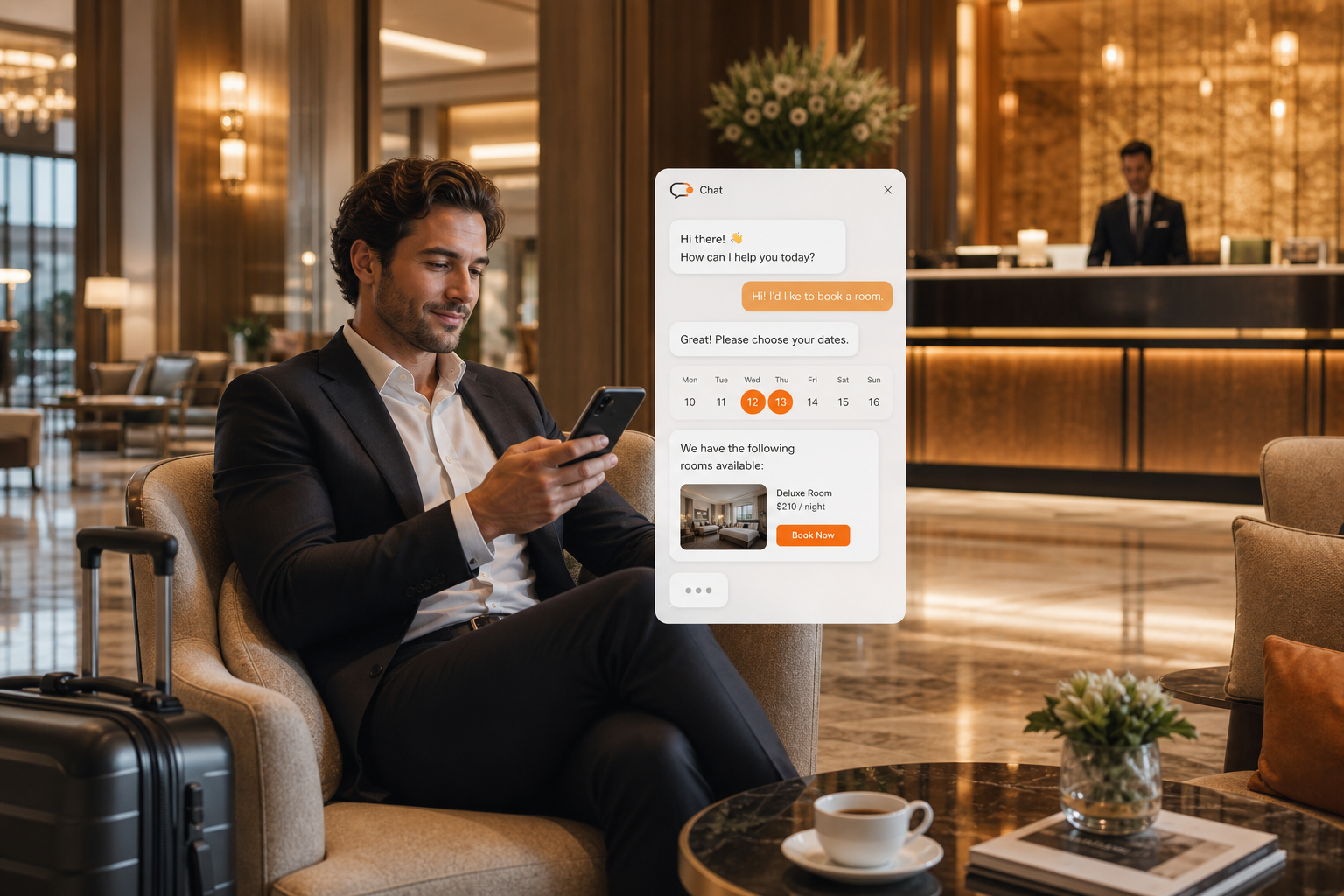
Yes. Modern AI chatbots can guide guests through the entire booking process, check real-time availability, apply discount codes, and either complete the transaction within chat or seamlessly redirect to your booking engine with pre-filled details. The level of direct booking capability depends on your PMS integration.
How long does it take to set up an AI chatbot for a hotel?
Setup time varies dramatically by platform. Enterprise solutions like HiJiffy or Asksuite typically require 1–3 weeks of onboarding. With Oscar Chat, you can have a trained, functioning chatbot live on your website in under 30 minutes by providing your URL and uploading your hotel’s FAQ document.
Will an AI chatbot replace my front desk staff?
No. AI chatbots handle repetitive, informational queries (60–80% of all guest questions) so your staff can focus on high-value interactions: resolving complex issues, providing personalized hospitality, and managing VIP guests. Think of it as removing the mundane so your team can do what humans do best.
What languages can hotel chatbots support?
Modern AI-powered chatbots support 50–100+ languages natively, with automatic language detection. This means a Japanese guest, German guest, and Brazilian guest can all communicate in their preferred language simultaneously—without requiring multilingual staff on duty.
How do hotel chatbots handle guest complaints?
Best practice is configuring sentiment detection that automatically escalates negative or emotional conversations to human staff. The chatbot acknowledges the issue, assures the guest that a team member is being notified, and routes the conversation to the appropriate department within seconds.
Can I use a hotel chatbot on WhatsApp and my website simultaneously?
Yes. Most modern platforms, including Oscar Chat, support omnichannel deployment. You manage all conversations—website chat, WhatsApp, Facebook Messenger—from a single dashboard. Guest context carries across channels, so they never have to repeat themselves.
How does an AI chatbot increase direct bookings over OTAs?
The chatbot engages website visitors proactively, answers questions instantly (removing the reason to search elsewhere), offers best-rate guarantees, recovers abandoned bookings with targeted follow-ups, and provides a frictionless path from “I have a question” to “I’ve booked.” Each interaction that stays on your site is one less OTA commission paid.
What data does a hotel chatbot collect from guests?
Chatbots collect conversation transcripts, contact information (email, phone when provided), booking preferences, language preferences, and behavioral data (pages visited, time on site). All data collection must comply with GDPR and local privacy regulations. Reputable platforms provide data processing agreements and configurable consent mechanisms.
Is an AI chatbot suitable for small boutique hotels or only large chains?
AI chatbots are arguably more impactful for small properties. Large chains have dedicated call centers and 24/7 staffing. A 20-room boutique hotel with 3 staff members gains proportionally more from automating repetitive questions, capturing after-hours inquiries, and converting website visitors who would otherwise bounce without booking.
Ready to see how an AI chatbot works for your hotel? Start your free Pro trial and have a trained chatbot live on your website in under 30 minutes—no credit card required, no developer needed. If you are still evaluating support stacks, read our guide to what live chat is.