This article defines each option plainly, compares them side by side, and ends with a practical checklist for deciding what your store actually needs — which is often a mix, not a single winner.
The three options, defined plainly
1. Rule-based chatbot
A rule-based chatbot follows a decision tree you build by hand: click “Track my order,” get the tracking flow; click “Returns,” get the returns flow. It matches keywords or button clicks against scripts you wrote in advance.
Strengths: completely predictable (it never says anything you didn’t write), cheap to run, fast to answer the five questions it was built for.
Weaknesses: brittle. The moment a customer asks something in their own words — “can I swap this for a bigger size?” instead of clicking Returns — the bot either loops, apologises, or dumps them into a contact form. Every new topic means another branch to write and maintain.
2. Live chat
Live chat is a human typing. A member of your team (or an outsourced agent) answers in real time during the hours the chat is staffed.
Strengths: judgement. Humans handle nuance, weird edge cases, angry customers, and sales conversations that need reading the room.
Weaknesses: someone has to be there. Live chat only works while staffed, it gets expensive roughly in proportion to how many conversations you have, and response quality depends on who’s on shift. Outside business hours, most live chat tools degrade into a “leave a message” form — which is just email with extra steps.
3. AI chat
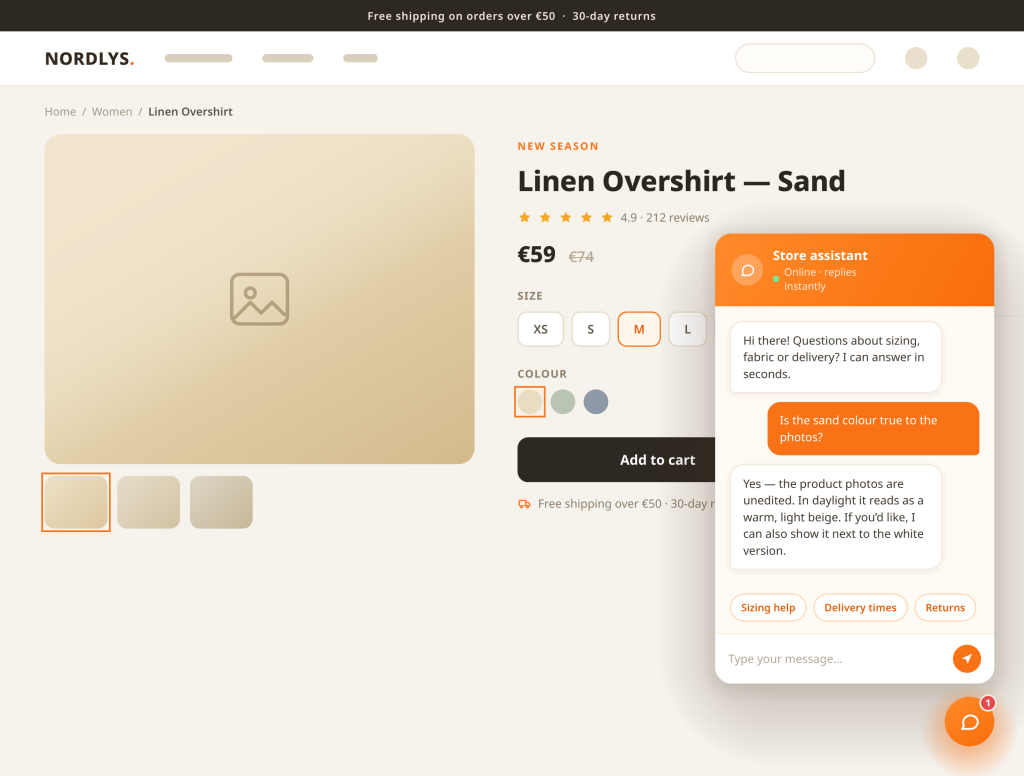
An AI chat agent is trained on your website content, product pages, FAQ and knowledge base, and answers in natural language, around the clock. A good one knows when to admit it doesn’t know and hands off gracefully.
Strengths: instant answers at 3 a.m., consistent quality, handles questions phrased any way a customer likes, scales without adding headcount, and — if it speaks your customers’ languages — works across borders without multilingual staffing.
Weaknesses: it needs training and occasional correction. Feed it thin or outdated content and answers get vague. And for genuinely emotional, high-stakes situations, a human is still better.
Why “chatbot” became a useless word
“Chatbot” used to mean the rule-based kind. Vendors now label almost anything “AI chatbot,” including keyword matchers with a fresh coat of paint. When you evaluate tools, ask one question: does it answer a question I haven’t scripted? Type a real customer question in your own wording into the demo. If it can only respond to buttons and exact keywords, it’s a rule-based bot regardless of the marketing.
Side by side
| Rule-based chatbot | Live chat | AI chat | |
|---|---|---|---|
| Who answers | Pre-written scripts | Your team, in real time | AI trained on your content |
| Availability | 24/7, but only on scripted topics | Business hours (staffed) | 24/7 |
| Handles unscripted questions | ✗ No | ✓ Yes, if staffed | ✓ Yes, within its training |
| Response time | Instant | Minutes, queue-dependent | Instant |
| Cost model | Usually cheap / bundled | Scales with headcount and volume | Flat per-seat or per-message/credit based |
| Maintenance | Constant script upkeep | Training and scheduling staff | Train once, review and correct answers |
| Best at | Simple routing, lead capture forms | Complex, emotional, high-value cases | Instant answers, after-hours, multilingual |
The honest trade-offs
Coverage vs control. Rule-based bots give you total control and almost no coverage. Live chat gives you depth and no reach. AI chat sits in the middle: broad coverage with control exercised through training data rather than scripts.
Cost shape. Live chat costs grow linearly — more conversations, more people. Rule-based bots are cheapest but quickly cap out. AI chat sits in the middle, usually priced per seat, per assistant, or with credit-based pricing — so check what a busy month costs you, not your average one.
Language. If you sell internationally, this is decisive. Hiring humans for every language your customers speak is unrealistic for most stores; a trained AI agent that answers in 50+ languages covers the long tail from day one. Oscar Chat answers in more than 50 languages out of the box.
Data you already have. AI chat is only as good as the content behind it. If your product pages, shipping and returns policies are already written on your site, training an agent is mostly a matter of pointing it at that content and fixing the gaps it reveals. If your knowledge lives in someone’s head, start by writing the FAQ down — any of the three options will thank you.
The setup most stores actually need
For most stores, the answer is a combination:
- AI chat as the first responder. It answers product, shipping, sizing and returns questions instantly, day and night, and catches the long tail of “does this work with…” questions.
- Human backup for the moments that matter. Complaints, high-value pre-sales, anything emotional. Let the AI gather context and hand over rather than improvise.
- Lead capture for everyone else. Not every visitor wants a conversation. A well-timed popup or form quietly collects emails from people who’d never open a chat. (Oscar Chat bundles a free Popup Builder and free Form Builder with the chat for exactly this reason.)
Rule-based flows still earn a place inside this setup for structured tasks — order tracking lookups, booking a call — where a button is genuinely faster than a sentence.
Decision checklist for store owners
Answer these honestly:
- Do customers ask questions outside your business hours? If yes, live chat alone will miss them. AI chat covers nights and weekends.
- Are your questions repetitive? If the same ten topics dominate, AI chat pays for itself fast. If every case is bespoke, prioritise humans.
- Do you sell in more than one language? Multilingual staffing is the most expensive way to answer this. AI chat handles it natively.
- Is your help content written down? Product pages, policies, FAQs. AI chat trains on it; without it, write the FAQ first.
- What does your busiest month look like? Check whether your shortlisted tool prices per message/credit (spiky) or flat per seat (predictable), and cost out December, not February.
- Who handles complaints today? Keep a human path for escalations regardless of what you automate.
- What happens to visitors who never chat? Pair the conversation layer with popups/forms so silent browsers still convert.
Two or more “yes” answers in the first four rows means AI chat should be your default, live chat your escalation path.
How Oscar Chat fits this picture
Oscar Chat is built around that combined model: an AI chat agent trained on your website content, an integrated popup and form builder, and live-chat handover to your team — sized for stores that need fast answers without hiring overnight staff. There is a free plan to start and paid plans as you grow — current prices are on the pricing page.
If you’re comparing AI chat tools specifically, our head-to-head posts go deeper: read Oscar Chat vs Chatbase on credit-based pricing, Oscar Chat vs Crisp for the live-chat-first alternative, and Oscar Chat vs Intercom if you’re weighing a large support platform. Already have a widget? how to train your AI chatbot covers getting better answers out of it.
7-Day Pro Trial for Every New Account
For your first 7 days, you are automatically on the Pro plan.
Start Free with Pro ↗FAQ
Is AI chat the same as a chatbot?
Not anymore. “Chatbot” originally meant rule-based bots that followed decision trees and scripts — if your question didn’t match a rule, the bot couldn’t help you. AI chat uses a language model, so it can understand questions phrased in different ways, answer follow-ups, and work from facts about your business rather than a fixed script. Most honest marketing now uses “chatbot” loosely for both, which is why the word doesn’t tell you much. Ask which one you’re actually getting: rule-based or AI.
Can AI chat fully replace live chat?
For routine questions, mostly yes — those usually make up a large share of the messages a store receives. For emotional or high-value conversations, where someone is upset or about to spend a lot of money, a human is worth more than a percentage point of automation. The sane setup for most stores is AI chat first, with a clear handover path to a human. If a tool forces you to pick one and only one, it’s not designed around how support actually works.
What does AI chat cost compared to live chat?
Live chat costs scale with people — each extra seating hour, weekend coverage, and headcount adds up. AI chat tools price their plans in different ways, so compare what sorts of plans they offer and what happens as your volume grows. Oscar Chat, for example, has a free plan to start and paid plans as you grow — current prices are on the pricing page.
How long does it take to set up AI chat?
For most stores, minutes to an hour. The quick wins come from pointing the AI at your existing website pages and your top customer questions, then reviewing what it says before going live. The multi-week implementations belong to enterprises with strict compliance processes, not to a store that wants to stop answering “where is my order” by hand at 11pm.
Does AI chat work in languages other than English?
Modern language models handle most European languages comfortably. Oscar Chat answers customers in the language they write in, which matters if you sell across borders.
What if the AI gives a wrong answer?
It will, occasionally. That’s why quality controls matter: training it only on your own content, testing it with real customer questions before launch, reviewing conversations afterwards, and setting clear boundaries so it says “I don’t know” and hands over instead of inventing an answer. A store that reviews its AI’s answers monthly will have fewer errors than one that never looks.