Why Car Dealerships Are Losing Leads After Hours
An AI chatbot for car dealerships solves this gap. It engages every visitor instantly, qualifies their intent, answers inventory questions, and books test drives—all without human intervention. This isn’t theoretical. Dealerships using AI chat are reporting 35–50% increases in qualified lead volume within the first 90 days.
What an AI Chatbot Actually Does for a Dealership
Forget the clunky rule-based bots from 2019 that frustrated customers with rigid decision trees. Modern AI chatbots use natural language processing to hold genuine conversations. A shopper can ask “Do you have any white RAV4s under $35K with low miles?” and get an accurate, instant response.
Core Capabilities
- 24/7 lead capture: Collects name, phone, email, and vehicle interest from every engaged visitor—day or night.
- Inventory search: Connects to your DMS or inventory feed to answer real-time stock questions.
- Test drive scheduling: Books appointments directly into your CRM calendar without back-and-forth.
- Trade-in conversations: Gathers vehicle details, mileage, and condition to pre-qualify trade-ins before the customer arrives.
- Finance pre-qualification: Asks preliminary credit and budget questions to route leads to the right F&I team member.
- Service appointment booking: Handles routine service scheduling for your fixed-ops department.
The key differentiator from generic chatbots versus live chat solutions is automotive-specific training. The bot understands trim levels, financing terminology, and the dealership buying journey.
Lead Capture: From Anonymous Visitor to Qualified Opportunity
Traditional dealership websites rely on static forms: “Fill out this form and we’ll get back to you.” The problem? Form completion rates on automotive sites average just 2.1%. Customers don’t want to fill out seven fields and wait for a callback.
AI chatbots flip this interaction. Instead of asking for information upfront, they provide value first—answering the shopper’s question—then naturally collect contact details as the conversation progresses.
The Conversational Lead Capture Flow
Step 1: Visitor lands on a VDP (Vehicle Detail Page) and the chatbot proactively offers help: “I can check if this Accord is still available and get you today’s best price. Want me to look into it?”
Step 2: The shopper engages. The bot confirms availability, mentions current incentives, and asks: “Would you like me to have our sales team send you the out-the-door price? I just need your name and email.”
Step 3: Contact details are captured and pushed to your CRM as a hot lead with full conversation context attached. Your sales team knows exactly what the customer wants before they pick up the phone.
This approach typically converts 15–25% of chat engagements into leads—a 7–12x improvement over static forms.
Automating Test Drive Scheduling
Test drives are the single highest-converting action in the car buying journey. A customer who takes a test drive purchases that vehicle 60–70% of the time. Yet most dealerships make booking one unnecessarily difficult.
An AI chatbot removes every friction point:
- Shows available time slots synced with your sales team’s calendar
- Confirms the specific vehicle the customer wants to drive
- Sends automated reminders via SMS or email to reduce no-shows
- Collects driver’s license information in advance for faster check-in
- Offers alternative vehicles if the requested model is unavailable
Dealerships that automate test drive booking through chat report a 40% reduction in no-show rates because the bot sends confirmation messages and day-of reminders automatically.
Comparing AI Chatbot Solutions for Car Dealerships
Not every chatbot is built for automotive. Here’s how the main approaches compare:
| Feature | Automotive-Specific Bot | Generic AI Chatbot | Rule-Based Chat Widget |
|---|---|---|---|
| Inventory integration | Native DMS sync | Requires custom API work | Not available |
| Test drive booking | Built-in calendar sync | Possible with setup | Basic form redirect |
| Natural language understanding | Trained on auto terminology | General-purpose NLP | Keyword matching only |
| CRM integration | Pre-built for VinSolutions, DealerSocket, etc. | Generic CRM connectors | Email/webhook only |
| Setup time | 1–2 weeks | 2–5 days | Same day |
| Monthly cost | $500–$2,000+ | $30–$200 | $0–$50 |
| Scalability beyond automotive | Limited | Any industry | Any industry |
For single-location dealers or dealer groups that want fast deployment without enterprise pricing, a versatile AI chatbot platform like Oscar Chat offers a practical middle ground. You get AI-powered conversations, lead capture, and appointment scheduling at a fraction of the cost of automotive-specific vendors—with the flexibility to train the bot on your inventory pages and dealership-specific FAQs.
ROI: What the Numbers Look Like
Let’s run the math for a mid-size dealership doing 150 new and used units per month:
| Metric | Before AI Chatbot | After AI Chatbot |
|---|---|---|
| Monthly website visitors | 12,000 | 12,000 |
| Lead conversion rate | 2.5% | 5.8% |
| Monthly leads generated | 300 | 696 |
| Test drives booked | 85 | 165 |
| Close rate from test drive | 65% | 65% |
| Additional units sold/month | — | ~52 |
| Avg. gross profit per unit | $2,800 | $2,800 |
| Additional monthly revenue | — | $145,600 |
Even conservative estimates show that an AI chatbot paying for itself within the first week of operation. When a single additional car sale covers months of chatbot subscription costs, the ROI discussion becomes straightforward.
Implementation: Getting Started in 5 Steps
You don’t need a six-month IT project to deploy an AI chatbot on your dealership website. Here’s the practical path:
Step 1: Define Your Primary Use Cases
Start focused. Most dealers see the fastest ROI from two use cases: after-hours lead capture and test drive scheduling. Don’t try to automate your entire BDC on day one.
Step 2: Choose Your Platform
Evaluate based on your dealership’s size and technical capabilities. If you need enterprise DMS integrations, you’ll pay enterprise prices. If you want a cost-effective AI chatbot that you can train on your specific inventory and processes, platforms like Oscar Chat let you get started in minutes rather than weeks. Check out our comparison of free live chat software, what live chat is, and Crisp alternatives if you’re evaluating options.
Step 3: Train the Bot on Your Dealership
Feed it your inventory pages, financing FAQs, service menu, hours of operation, and common customer questions. The more context you provide, the more accurately it represents your dealership.
Step 4: Set Up Routing Rules
Configure when the bot should hand off to a human agent. Hot leads asking about pricing on a specific vehicle? Route to your top closer immediately. General questions about service hours? The bot handles those autonomously.
Step 5: Connect Your CRM
Ensure every captured lead flows directly into your existing CRM with full conversation context. Your sales team should never need to manually transfer information from chat to their follow-up system.
Best Practices for Dealership AI Chat
After analyzing hundreds of dealership chat deployments, these practices separate high-performing implementations from underperformers:
- Proactive engagement on VDPs: Don’t wait for visitors to click the chat icon. Trigger a contextual message after 15–20 seconds on a vehicle detail page: “Interested in this 2024 Camry? I can check if it’s still on the lot.”
- Mobile-first design: Over 65% of dealership website traffic comes from mobile. Your chatbot must be thumb-friendly with quick-reply buttons for common actions.
- Speed to lead: Configure instant notifications to your sales team when a high-intent lead is captured. The first dealership to respond wins 78% of the time.
- After-hours messaging: Adjust the bot’s tone and expectations after hours. Be transparent that it’s AI, but assure customers their inquiry will be prioritized first thing in the morning.
- Trade-in qualification: Use the chat to gather year, make, model, mileage, and condition before the customer arrives. This saves 20–30 minutes of in-person time and shows the customer you’re prepared.
Common Mistakes to Avoid
Dealerships that struggle with chatbot ROI typically make these errors:
- Over-automating: Trying to handle complex negotiations or complaints through AI. These should always route to experienced staff.
- Ignoring chat leads: A chatbot generates leads, but your team must still follow up promptly. Without process changes, more leads just means more missed opportunities.
- Generic messaging: Using the same chatbot script for new car shoppers, used car buyers, and service customers. Each audience needs tailored conversation flows.
- No A/B testing: Running the same proactive messages for months without testing alternatives. Small wording changes can dramatically impact engagement rates.
- Hiding the human option: Always provide a clear path to speak with a real person. Customers who feel trapped in a bot conversation leave frustrated—and leave negative reviews.
Beyond Sales: Service Department Applications
While lead capture gets the headlines, dealership AI chatbots deliver significant value in fixed operations too:
- Service scheduling: Customers book oil changes, tire rotations, and recalls without calling. This reduces phone volume by 25–40%.
- Status updates: “Is my car ready?” queries handled instantly by checking your service management system.
- Recall notifications: Proactively inform visitors about open recalls on their vehicle and offer one-click booking.
- Parts inquiries: Answer common parts availability questions and take special-order requests.
Service departments that deploy AI chat typically see a 30% increase in online-booked appointments and significantly fewer inbound phone calls, freeing advisors to focus on in-store customers.
How Oscar Chat Fits the Dealership Use Case
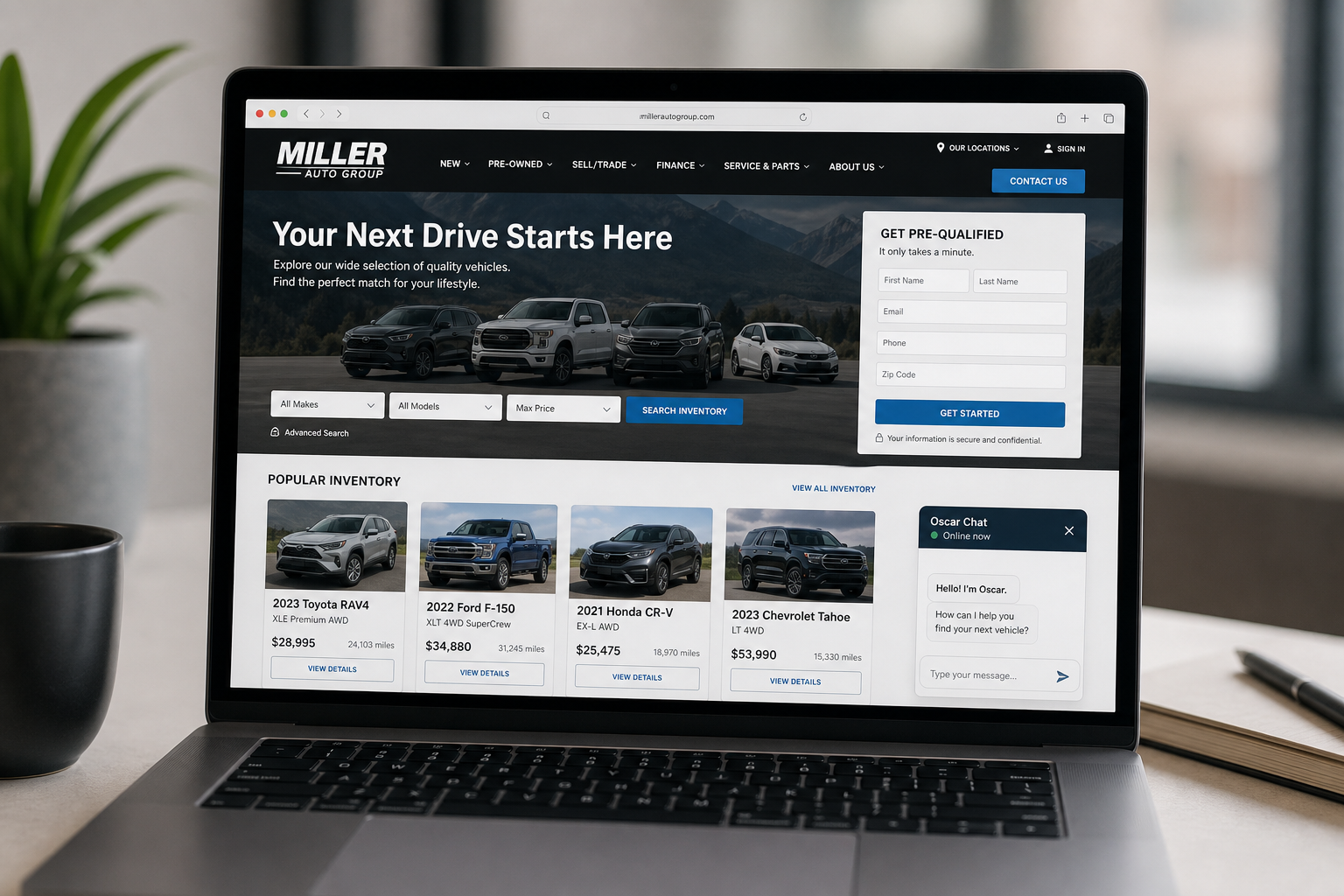
Oscar Chat provides an AI-powered chatbot that dealerships can deploy in minutes. Unlike enterprise automotive platforms that require lengthy onboarding, Oscar Chat lets you:
- Train the AI on your dealership website and inventory pages automatically
- Capture leads with customizable forms that push to your CRM
- Set up live chat handoff for high-intent conversations
- Deploy across your website, Facebook, and WhatsApp from a single dashboard
- Start with a 7-day Pro trial to test the full feature set risk-free
For multi-location dealer groups, the platform scales across all your stores with centralized management. For independent dealers watching their budget, pricing starts significantly lower than automotive-specific vendors while delivering the same core functionality: lead capture, appointment booking, and 24/7 availability.
Try Oscar Chat Free for 7 Days
Frequently Asked Questions
What is an AI chatbot for car dealerships?
An AI chatbot for car dealerships is an automated conversational tool that engages website visitors, answers vehicle and financing questions, captures lead information, and schedules test drives—all without requiring a human agent to be present. It uses natural language processing to understand automotive-specific queries and respond accurately.
How does an AI chatbot capture leads for a dealership?
The chatbot engages visitors through proactive, contextual messages on vehicle pages. As it provides value—checking availability, sharing pricing, or answering questions—it naturally collects contact information. Leads are then pushed to your CRM with full conversation context so your sales team can follow up with relevant, personalized outreach.
Can an AI chatbot schedule test drives automatically?
Yes. Modern AI chatbots integrate with your dealership’s calendar system to show available time slots, confirm the specific vehicle the customer wants to test drive, and send automated reminders. This eliminates phone tag and reduces no-show rates by up to 40%.
How much does a dealership AI chatbot cost?
Costs range widely. Automotive-specific enterprise solutions run $500–$2,000+ per month. General-purpose AI chatbot platforms like Oscar Chat offer similar core functionality (lead capture, scheduling, 24/7 availability) starting at $30–$200 per month, making them accessible to independent dealers and smaller groups.
Will customers know they’re chatting with a bot?
Best practice is to be transparent that the initial conversation is AI-powered while making it clear a human is available on request. Most customers don’t mind chatting with AI as long as it provides accurate, helpful answers quickly. Transparency builds trust and avoids frustration.
Does an AI chatbot replace my BDC team?
No. An AI chatbot augments your BDC team by handling routine inquiries, capturing after-hours leads, and qualifying prospects before handoff. Your team focuses on high-value activities: closing deals, handling complex negotiations, and building relationships. Think of the bot as a tireless first responder, not a replacement for skilled salespeople.
How long does it take to set up an AI chatbot on a dealership website?
Setup time varies by platform. Enterprise automotive solutions may take 1–2 weeks with DMS integrations. Platforms like Oscar Chat can be deployed in under 30 minutes—you add a code snippet to your site and train the AI on your pages. Basic lead capture works immediately; deeper integrations take a few days.
Can the chatbot answer questions about specific vehicles in my inventory?
Yes, if connected to your inventory feed or trained on your VDP pages. The bot can confirm availability, share pricing, list features, and compare trim levels. For dealerships without API access to their DMS, training the bot on your website pages still provides accurate responses for listed inventory.
What happens when the chatbot can’t answer a question?
A well-configured chatbot gracefully hands off to a human agent when it reaches its limits. During business hours, this means a live transfer. After hours, it captures the customer’s question and contact info, assures them a team member will follow up, and flags the inquiry as priority for the next morning.
How do I measure the ROI of a dealership AI chatbot?
Track these key metrics: chat engagement rate, lead capture rate (chats that become CRM contacts), test drives booked through chat, show rate for chatbot-booked appointments, and units sold from chat-originated leads. Compare your cost-per-lead from chat against other channels like paid search and third-party lead providers. Most dealers see positive ROI within the first month.