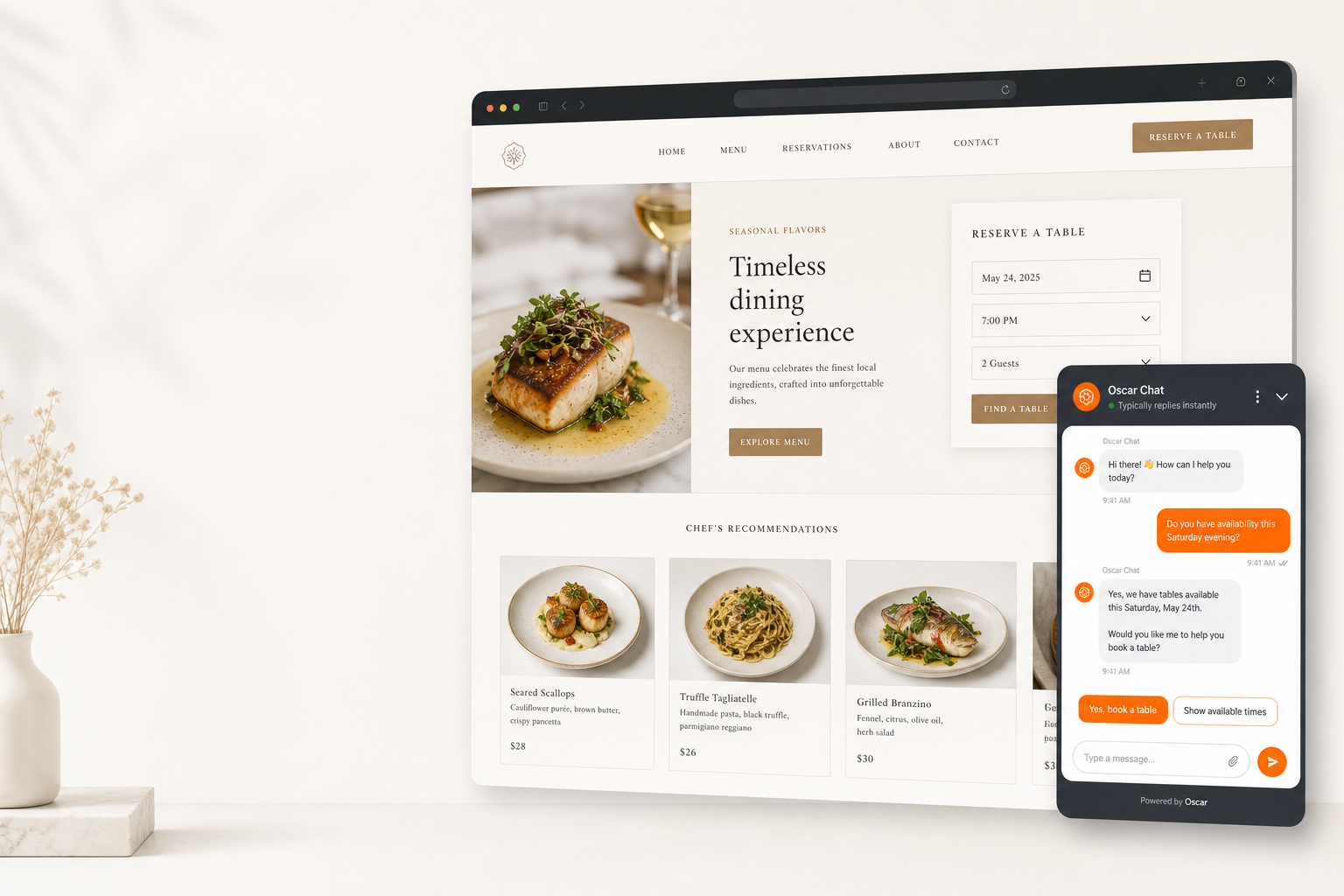
73% of restaurant reservations are researched outside business hours, yet most restaurants capture only a fraction of this demand. Meanwhile, savvy operators using AI chatbots report 35% increases in online reservations and 50% reductions in phone interruptions during dinner service.
The math is simple: every hour your restaurant website can’t book tables, answer questions, or help customers, you’re hemorrhaging revenue to competitors who embrace intelligent automation. Modern diners expect instant responses, seamless booking, and 24/7 accessibility—exactly what AI chatbot restaurant website integration delivers.
Why Restaurant Websites Need AI Chatbots
Modern diners expect immediate responses and seamless digital experiences. When someone visits your restaurant website at midnight wondering about your weekend specials or trying to make a last-minute reservation, an AI chatbot restaurant website system ensures they get instant, helpful responses instead of bouncing to a competitor.
The Current State of Restaurant Customer Service
Most restaurant websites still rely on static contact forms, phone calls during business hours, and basic information pages. This creates several pain points:
- Limited availability: Phone lines are only open during business hours
- High abandonment rates: Customers leave if they can’t find information quickly
- Missed reservations: Potential bookings are lost when staff are busy
- Repetitive inquiries: Staff spend time answering the same questions repeatedly
- Language barriers: International customers may struggle with communication
An AI chatbot restaurant website integration addresses all these challenges while providing additional benefits that directly impact your bottom line.
Core Benefits of AI Chatbot Restaurant Website Integration
1. 24/7 Reservation Management
Your AI chatbot restaurant website can handle reservations around the clock, even when your restaurant is closed. Customers can book tables for future dates, check availability, and receive immediate confirmation. This eliminates the frustration of calling during busy periods or outside business hours.
The system can integrate with your existing reservation management software, ensuring real-time availability updates and preventing double-bookings. Advanced AI chatbots can also handle special requests, dietary restrictions, and party size modifications.
2. Instant Menu Information and Recommendations
Customers frequently visit restaurant websites to browse menus, check prices, and understand dietary options. An AI chatbot restaurant website can provide personalized menu recommendations based on customer preferences, dietary restrictions, or budget considerations.
The chatbot can answer specific questions like:
- “What vegetarian options do you have?”
- “Which dishes are gluten-free?”
- “What’s your most popular appetizer?”
- “Do you have kid-friendly meals?”
3. Order Management and Delivery Coordination
For restaurants offering takeout or delivery, an AI chatbot restaurant website can streamline the entire ordering process. Customers can browse menus, customize orders, select pickup or delivery times, and make payments without ever leaving your website.
This reduces dependency on third-party delivery platforms and their associated fees while maintaining direct customer relationships. The chatbot can also provide order status updates and estimated preparation times. Similar to how AI chatbots help reduce cart abandonment in e-commerce, restaurant chatbots can guide customers through the complete ordering process to minimize drop-offs.
4. Enhanced Customer Experience Through Personalization
Modern AI chatbots learn from customer interactions, enabling personalized experiences that feel natural and helpful. When a returning customer visits your website, the AI chatbot restaurant website system can remember their preferences, suggest similar dishes, or remind them about loyalty program benefits.
This level of personalization was previously only possible through human staff who recognized regular customers, but AI extends this personal touch to your digital presence.
Essential Features for Restaurant AI Chatbots
Multi-Language Support
In diverse communities, offering multi-language support through your AI chatbot restaurant website can significantly expand your customer base. The chatbot can detect customer language preferences and communicate fluently in multiple languages, breaking down barriers that might prevent potential customers from engaging with your restaurant.
Integration with POS Systems
The most effective AI chatbot restaurant website solutions integrate seamlessly with your point-of-sale system, ensuring real-time synchronization of menu items, prices, and availability. This prevents the frustration of customers ordering items that are temporarily unavailable.
Smart Queue Management
During peak hours, an AI chatbot restaurant website can help manage customer expectations by providing accurate wait times, allowing customers to join virtual queues, or suggesting optimal times to visit. This reduces crowding and improves the overall dining experience.
Special Events and Promotions Management
Your AI chatbot can proactively inform customers about special events, seasonal menus, happy hour deals, and promotional offers. This automated marketing approach ensures consistent communication and can drive revenue during slower periods. For restaurants that want to maximize engagement, personalizing chat greetings for higher conversions can significantly improve customer interaction quality.
Implementation Strategies for Different Restaurant Types
Fine Dining Establishments
Fine dining restaurants require AI chatbot restaurant website solutions that maintain their sophisticated brand image while providing exceptional service. The chatbot should use formal language, understand wine pairing requests, handle special occasion bookings, and provide detailed information about chef specialties or seasonal ingredients.
Key features for fine dining include:
- Wine selection assistance and pairing recommendations
- Special occasion package information
- Dietary restriction accommodations
- Private dining room availability
- Dress code information
Casual Dining and Family Restaurants
Casual dining establishments benefit from AI chatbot restaurant website systems that are friendly, approachable, and efficient. These chatbots should excel at handling family-size orders, kids’ menu questions, and group reservations.
Important capabilities include:
- Family-friendly menu recommendations
- High chair and booster seat availability
- Birthday party packages
- Group booking management
- Allergen information
Fast-Casual and Quick Service
Quick-service restaurants need AI chatbot restaurant website solutions focused on speed and efficiency. The emphasis should be on rapid order processing, accurate delivery estimates, and seamless payment integration.
Essential features include:
- Rapid order customization
- Real-time preparation times
- Loyalty program integration
- Mobile-optimized interfaces
- Express pickup options
Setting Up Your AI Chatbot Restaurant Website
Choosing the Right Platform
When selecting an AI chatbot platform for your restaurant website, consider solutions like Oscar Chat that offer restaurant-specific features and easy integration. The platform should provide:
- No-code setup options for non-technical users
- Restaurant-specific templates and workflows
- Integration capabilities with reservation systems
- Customizable conversation flows
- Analytics and reporting features
Customizing Conversation Flows
Your AI chatbot restaurant website should reflect your brand personality and operational needs. Start by mapping out common customer inquiries and designing conversation flows that guide users toward desired actions like making reservations or placing orders.
Consider creating specialized flows for:
- Reservation requests with date, time, and party size collection
- Menu inquiries with filtering options
- Special dietary needs and allergen information
- Takeout and delivery orders
- Event planning and private dining
Training Your AI Chatbot
The effectiveness of your AI chatbot restaurant website depends on comprehensive training with restaurant-specific scenarios. Provide the chatbot with detailed information about:
- Complete menu descriptions and pricing
- Reservation policies and procedures
- Common customer questions and appropriate responses
- Staff escalation protocols for complex issues
- Brand voice and communication style guidelines
Integration with Existing Systems
Ensure your AI chatbot restaurant website integrates smoothly with your current technology stack. This typically includes:
- Reservation management systems
- POS software
- Inventory management
- Customer relationship management (CRM) tools
- Email marketing platforms
Best Practices for Restaurant AI Chatbots
Maintaining the Human Touch
While automation is powerful, restaurants are ultimately about hospitality and human connection. Your AI chatbot restaurant website should enhance rather than replace human interaction. Design the system to escalate complex requests to human staff and always provide options for customers who prefer speaking with a person.
Regular Content Updates
Restaurant information changes frequently—menu items, prices, hours, and specials all require regular updates. Establish a routine for keeping your AI chatbot restaurant website information current to maintain customer trust and prevent disappointment.
Monitoring and Optimization
Continuously analyze chatbot performance metrics to identify areas for improvement. Key metrics include:
- Response accuracy rates
- Customer satisfaction scores
- Conversion rates from chat to reservation/order
- Common escalation reasons
- Average conversation duration
Privacy and Data Security
Restaurants handle sensitive customer information including payment details, contact information, and dining preferences. Ensure your AI chatbot restaurant website complies with relevant data protection regulations and maintains robust security measures.
Measuring Success and ROI
Key Performance Indicators
Track specific metrics to evaluate your AI chatbot restaurant website performance:
Operational Metrics:
- Reservation booking rates through the chatbot
- Order conversion rates
- Average response time
- Customer inquiry resolution rate
Business Impact Metrics:
- Revenue attributed to chatbot interactions
- Reduction in phone call volume
- Increase in off-peak reservations
- Customer retention rates
Customer Experience Metrics:
- Customer satisfaction scores
- Chatbot interaction ratings
- Repeat usage rates
- Escalation to human staff frequency
Calculating Return on Investment
Most restaurants see positive ROI from AI chatbot restaurant website implementation within 3-6 months. Similar to how the best AI chatbots for Shopify stores in 2026 deliver measurable returns, restaurant chatbots provide quantifiable benefits. Consider both direct revenue increases and operational cost savings:
Revenue Increases:
- Additional reservations captured outside business hours
- Increased average order values through upselling
- Higher customer retention through improved service
Cost Savings:
- Reduced staff time handling routine inquiries
- Lower dependency on expensive third-party platforms
- Decreased missed reservations and no-shows
Advanced AI Chatbot Features for Restaurants
Predictive Analytics and Insights
Advanced AI chatbot restaurant website solutions can analyze conversation patterns to provide valuable business insights. This includes identifying popular menu items, peak inquiry times, common customer concerns, and seasonal trends.
These insights help restaurants make data-driven decisions about:
- Menu optimization and pricing strategies
- Staffing levels during different periods
- Marketing campaign timing and messaging
- Inventory management and purchasing
Voice Integration and Accessibility
Modern AI chatbots can include voice capabilities, making your restaurant website more accessible to customers with disabilities or those who prefer voice interaction. This technology is particularly useful for customers who may be driving or multitasking while trying to make reservations.
Social Media Integration
Extend your AI chatbot restaurant website functionality to social media platforms where customers often discover and engage with restaurants. This creates a consistent experience across all digital touchpoints and captures leads from various sources.
Common Implementation Challenges and Solutions
Managing Customer Expectations
Some customers may have unrealistic expectations about AI chatbot capabilities. Address this by:
- Clearly communicating what the chatbot can and cannot do
- Providing easy paths to human assistance
- Setting appropriate response time expectations
- Regular system maintenance and updates
Staff Training and Adoption
Restaurant staff need training on how the AI chatbot restaurant website integrates with their workflows. Ensure team members understand:
- How to access chatbot-generated reservations and orders
- When and how to take over conversations from the AI
- How to update chatbot information as menus change
- The benefits of the system for their daily work
Technical Integration Challenges
Work with experienced providers who understand restaurant technology ecosystems and can provide ongoing support during the implementation process.
Future Trends in Restaurant AI Chatbots
Enhanced Personalization Through Machine Learning
Future AI chatbot restaurant website solutions will leverage advanced machine learning to provide even more personalized experiences, including:
- Predictive ordering based on past behavior and external factors
- Dynamic pricing optimization
- Personalized loyalty rewards and offers
- Smart recommendation engines
Augmented Reality Menu Integration
Emerging technologies may allow AI chatbots to provide augmented reality menu experiences, helping customers visualize dishes and make more informed ordering decisions directly through the chatbot interface.
Integration with Smart Home Devices
As smart home adoption continues, restaurant AI chatbots may integrate with devices like Amazon Alexa or Google Assistant, allowing customers to make reservations or place orders through voice commands at home.
Getting Started with Oscar Chat for Restaurants
Oscar Chat provides restaurant-specific AI chatbot solutions that are easy to implement and customize for your unique needs. The platform offers:
- Restaurant-specific conversation templates
- Integration with popular reservation and POS systems
- Customizable branding and messaging
- Comprehensive analytics and reporting
- 24/7 technical support
To begin implementing an AI chatbot restaurant website solution, consider starting with a free trial of Oscar Chat to explore how the technology can benefit your specific restaurant operations.
Frequently Asked Questions
Q: How long does it take to set up an AI chatbot for a restaurant website?
A: Most restaurant AI chatbot implementations can be completed within 1-2 weeks, depending on the complexity of integrations with existing systems and the level of customization required.
Q: Can an AI chatbot handle complex dietary restrictions and allergen questions?
A: Yes, modern AI chatbots can be trained with comprehensive menu information including ingredients, allergens, and dietary classifications to provide accurate responses to customer inquiries.
Q: Will an AI chatbot replace human staff in restaurants?
A: No, AI chatbots are designed to handle routine inquiries and tasks, freeing human staff to focus on providing exceptional in-person hospitality and handling complex customer needs.
Q: How much does an AI chatbot restaurant website solution cost?
A: Costs vary depending on features and restaurant size, but most solutions offer tiered pricing starting around $50-100 per month for basic functionality, with enterprise solutions for larger restaurant groups.
Q: Can customers still reach human staff if needed?
A: Absolutely. Well-designed AI chatbot restaurant website systems always include clear paths for customers to connect with human staff when needed or preferred.
Q: How do AI chatbots handle peak dining hours and high website traffic?
A: AI chatbots are designed to handle unlimited simultaneous conversations, actually performing better during high-traffic periods when human phone lines might be overwhelmed.
Q: What happens if the AI chatbot doesn’t understand a customer question?
A: Modern AI chatbots are programmed with fallback responses and escalation procedures to ensure customers always receive helpful assistance, either through alternative phrasing or connection to human staff.
Q: Can AI chatbots integrate with third-party delivery platforms?
A: Many AI chatbot solutions can integrate with popular delivery platforms while also encouraging direct orders through your restaurant website to reduce third-party fees.
Q: How do AI chatbots handle multiple languages for diverse customer bases?
A: Advanced AI chatbots offer multi-language support, automatically detecting customer language preferences and communicating fluently in dozens of languages, making your restaurant accessible to international visitors and diverse local communities.
Q: Can restaurant AI chatbots help with staff training and onboarding?
A: Yes, AI chatbots can serve as training tools for new staff by providing instant access to menu information, policies, procedures, and common customer scenarios, helping reduce training time and improve service consistency.
Frequently Asked Questions
How can an AI chatbot help restaurants?
An AI chatbot can answer repeat questions, collect visitor details, qualify intent, and route important conversations to the right person.
What questions should a chatbot answer for restaurants?
It should answer the questions visitors ask most often, such as pricing, availability, booking, services, policies, delivery, support, and next steps.
Can AI chatbots generate leads?
Yes. A chatbot can capture contact details, qualify visitor intent, and guide high-intent visitors toward booking, buying, or requesting a quote.
Should the chatbot include human handoff?
Yes. Human handoff is important for complex questions, sensitive issues, custom requests, and high-value opportunities.
How should teams improve the chatbot over time?
Review transcripts, identify unanswered questions, add better knowledge, improve page prompts, and measure conversion after chat.
How does Oscar Chat help?
Oscar Chat brings AI chatbot, live chat, popups, forms, and lead capture into one platform so teams can support visitors and improve conversions.